AND ALL OUR SKIN IS BUT A CAGE,
A TOMB, A GRUESOME SCENE; AND ALL OUR SINS
LOOK LIKE A SNAKE, A COIL, DISCARDED SKEIN...
                    ——Buck Chadwick,
                  "'Hanging Chad': How The 'Death-Bucking Deer'
                    Kicked His Own Bucket"
Last week Monday, I decided to pay a visit to my garden.
It was a bright and lethargic afternoon, and something heavy was in the air. It was the day Trump declared a "public safety emergency" in the United States capital, deploying 800 National Guard troops to "clean up" the streets of D.C.. I had spent the embattled morning swatting away the needling impulse to return to bed, but it hung around me like some relentless mosquito. Nevermind that I was more well-rested than usual; I was still, for some reason, tired. And I could not find the thing responsible for the clarion buzzing that grew louder and more pernicious as the sun rose higher in the sky.
It was that uneasy period of day around one o'clock, when the morning doesn't realize it's over and the afternoon doesn't know how to begin: an unavoidable crossroads that imbues every action with annoyingly momentous import. One wrong move, and the day may be shot. It doesn't matter if you have all the pep in the world, if the mind buckles under all the pressure, opting to wander off like a disoriented relative who mysteriously vanishes the moment you're ready to check out at the store. Ubi sunt?
Readiness and stagnancy, impulsivity and uncertainty: a stalemate of opposing forces that makes me yawn uncontrollably, the only way to vent the kinetic energy, now at the point of rupturing, as every pent-up cell begs for the permission to move, to run—but to where? And from what? There is nowhere to go, no recourse but to hide in bed until the unbearable tension subsides, and the day roars on without us.
So, on the day in question, that is precisely what I planned to do. By the time afternoon rolled around, the soporific air had become so burdensome, it was practically shoving me down into a corpse pose. I probably could have made it further into the day, but some struggles are pointless. Maybe the imaginary tick I was always checking for was real after all. Or one of the many mosquitoes that bit me all summer was one of the carriers of West Nile virus. Maybe it was the angel of death reigning down his progeny to cause so much chaos and mayhem that humanity would collectively decide to shut the book on itsef once and for all, in acknowledgment that there can be no good ending to the story. Maybe some things don't need an ending. They just need to end.
And so, it was with palpable relief that I surrendered to the thanatotic temptation to just say fuck it and go to bed in the middle of the day. But this was, as the cliche goes, only the beginning, for no sooner had I arrived at the decision to hit the hay than I heard a subtle knocking. What's that? Who's there? A remorseful twinge. A furtive inclination that I should check the garden before checking out entirely.
With that, I resolved to take this detour to go "say hi to the garden," as I call it. I usually have no idea what this greeting will entail, nor for how long. It can range from a few minutes of menial upkeep, such as watering, or staking any plants that may have grown too big for their britches, to hours of gazing and gasping at all the infinitesimal changes.
I had a hand in creating the little world, but since then, it's been out of my hands what goes on there. I let it tell me what to do. Impetuousness is the principle. Leap before I look. I've had to learn the lesson, again and again, that whatever I think is going to happen when I get there—or when I get anywhere—never comes close to what actually occurs. More often than not, there is something totally unimaginable and unexpected waiting to jump out at me. Even if I find nothing, it's still something in a place that is always changing.
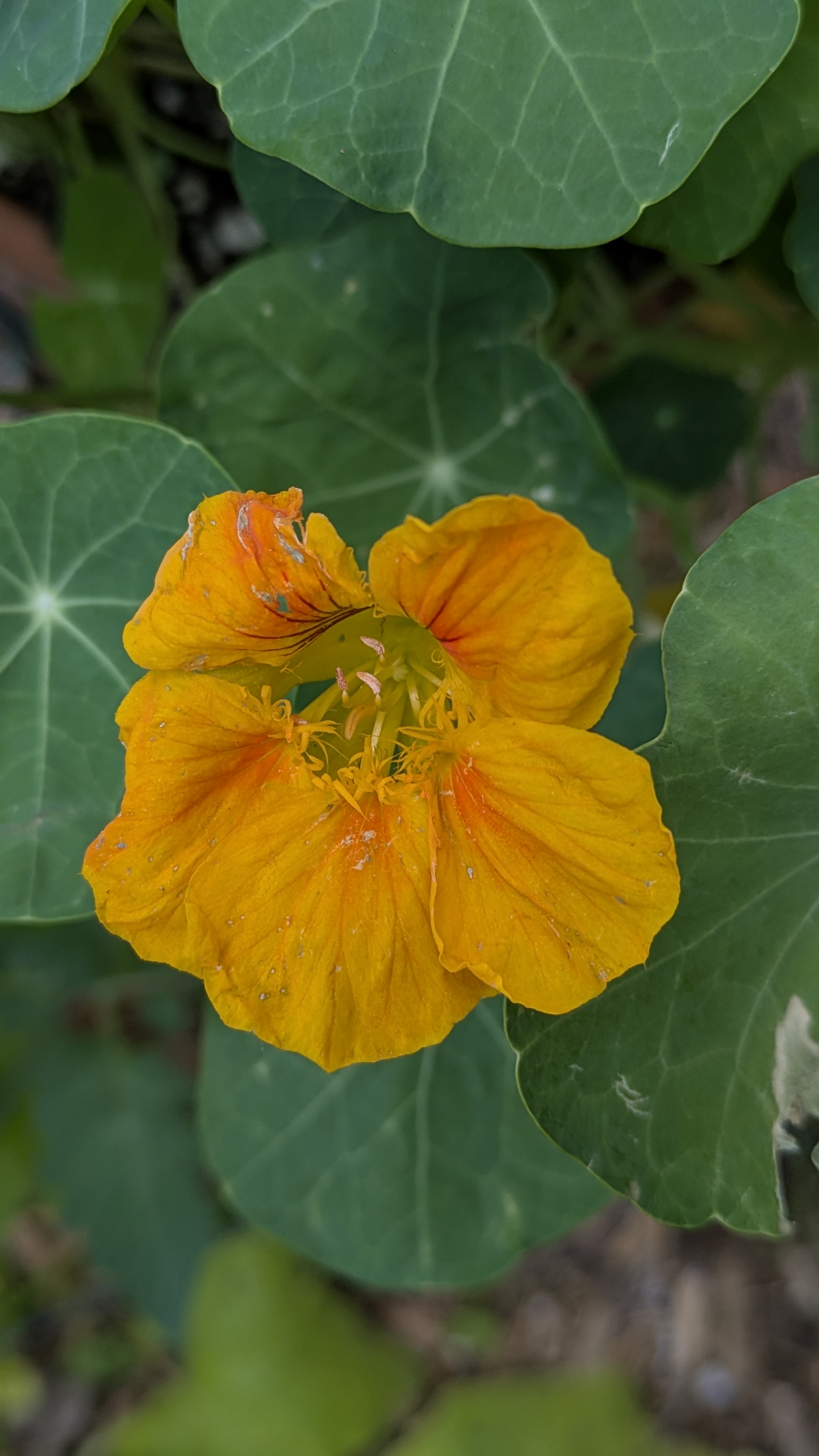
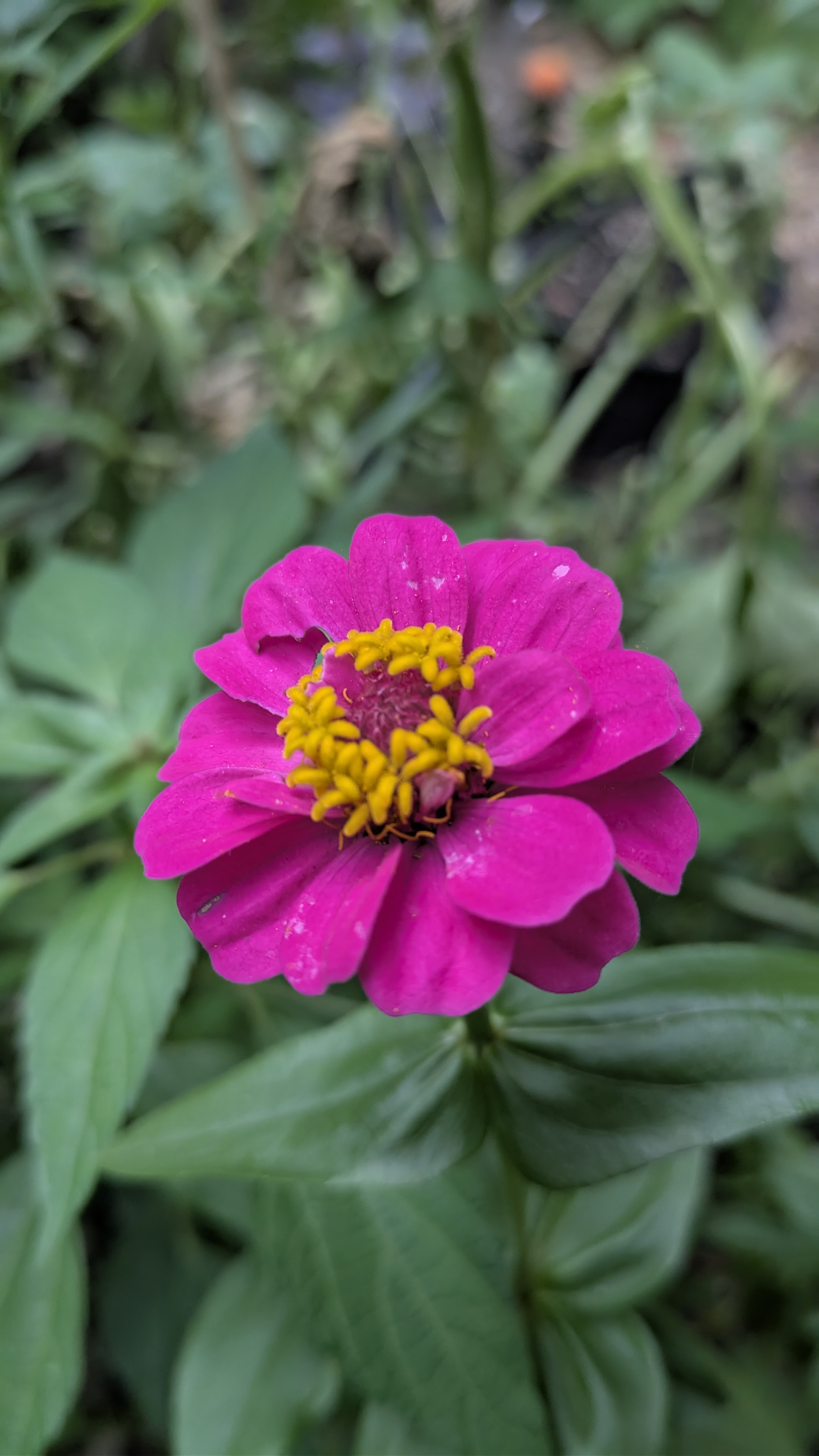
It could be a floral whiff that hits you right in the face, as you look to see new blooms staring you dead in the eye, having opened their petals, a revelation that took months of waiting, wondering, watching... Golden nasturtiums, flecked with meticulous streaks of vermillion; electrifying hot pink of the zinnias (Figs. 1-5).
Fig. 1. Nasturtium. Photograph by Andrea Fabbro, 2025. Grand Rapids, Michigan.
Fig. 2. Zinnia. Photograph by Andrea Fabbro, 2025. Grand Rapids, Michigan.
The regretable taste of bitter bolted sorrel that singes the tongue; the satisfying pluck of purslane leaves I pop into my mouth like potato chips, to help keep the succulent's explosive growth under control.
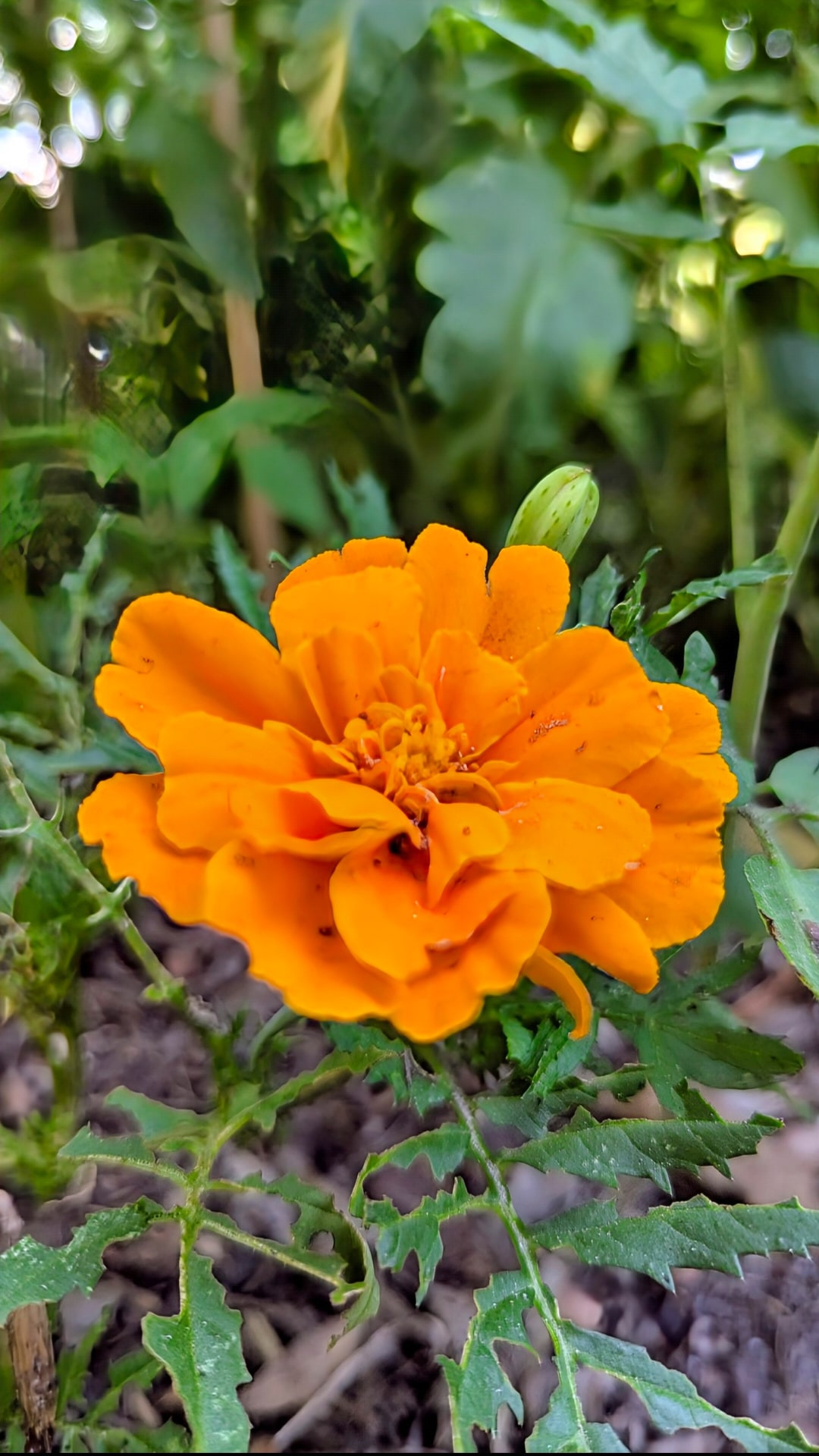
A sensory blast of perpetual newness: new branches, new buds, a new color scheme, warm one day and cool the next; new fruits and flowers; new seedlings, diseases, weeds, pests, and ideas. Every day, new textures, new ways for plants to lean against one another, new slants of noonday light to illuminate tenuous new compositions, as exquisite as they are temporary, blazing against the sun for a few shrinking moments, as long as an onlique ray of light can hold its position before it's all engulfed by the shade once more, whereupon new swirls of color will pop up like an obscene jack-in-the-box that clambers to be seen, as it complements and clashes with its showy rivals; a succession of shock after shock until the very last light of day passes through the cornea. And what a day it has been! A rotating potpourri that overwhelms and cleanses, stops the clock on anxiety, stultifies the tenure of pain.
Fig. 3. French Marigold. Photograph by Andrea Fabbro, 2025. Grand Rapids, Michigan.
And then sometimes taken aback by a tiny cluster of chartreuse chutes waving from a sick plant's pallid stem, a plant you did everything to save, its old, withering leaves suddenly flush with a deepening verdancy, dark pine green, the hue of vitality itself. And maybe there is hope after all, if not in our world then this much greater one growing out of the ground, as whatever steps led to this miraculous green must have been correct. And in this sudden clarity of right and wrong and good and bad, a path unfolds, comprised of questions. What else needs saving? And what needs to be let go? And the right thing to do, for once, is obvious.
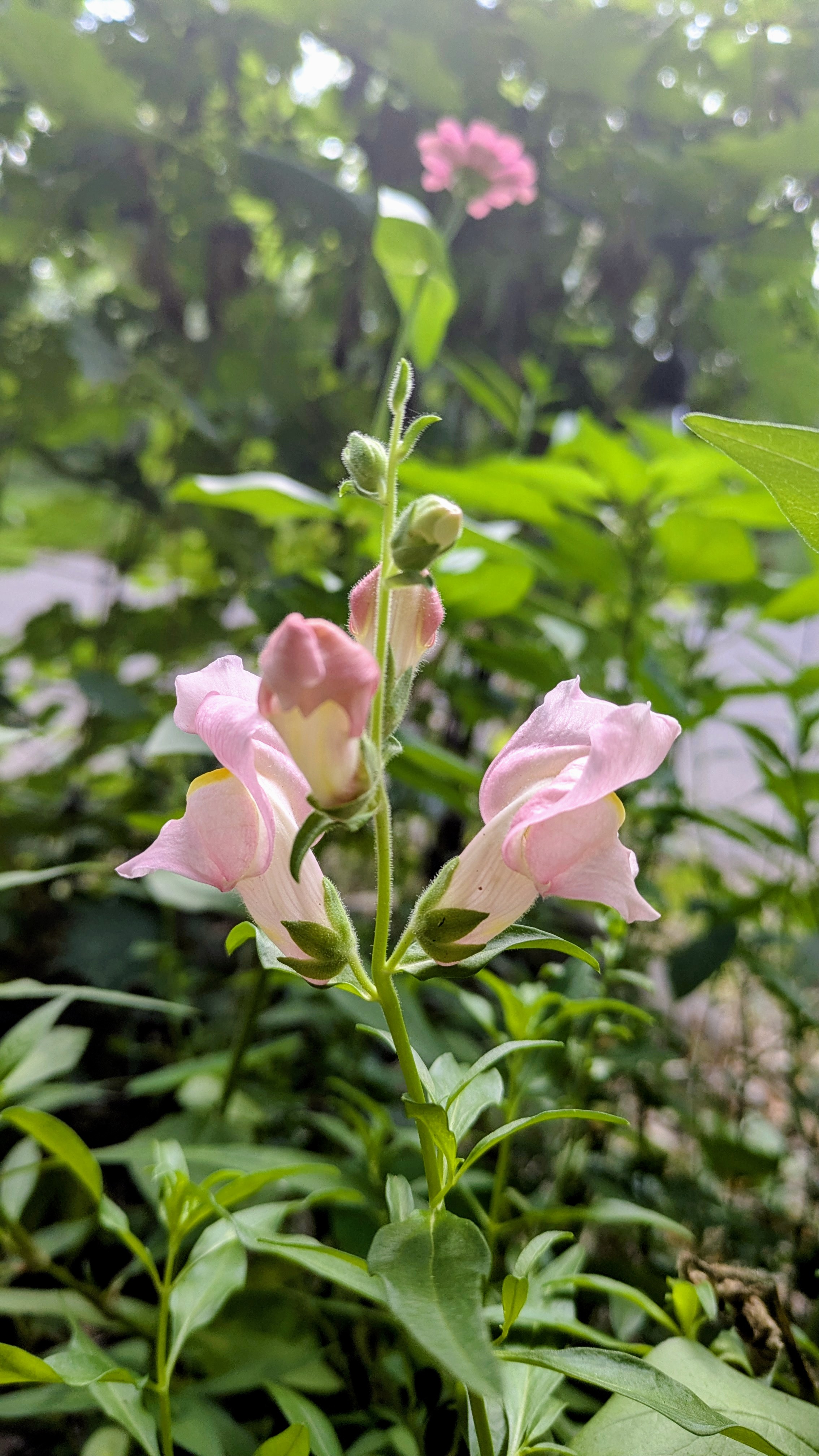
Fig. 4. Snapdragons. Photograph by Andrea Fabbro, 2025. Grand Rapids, Michigan.
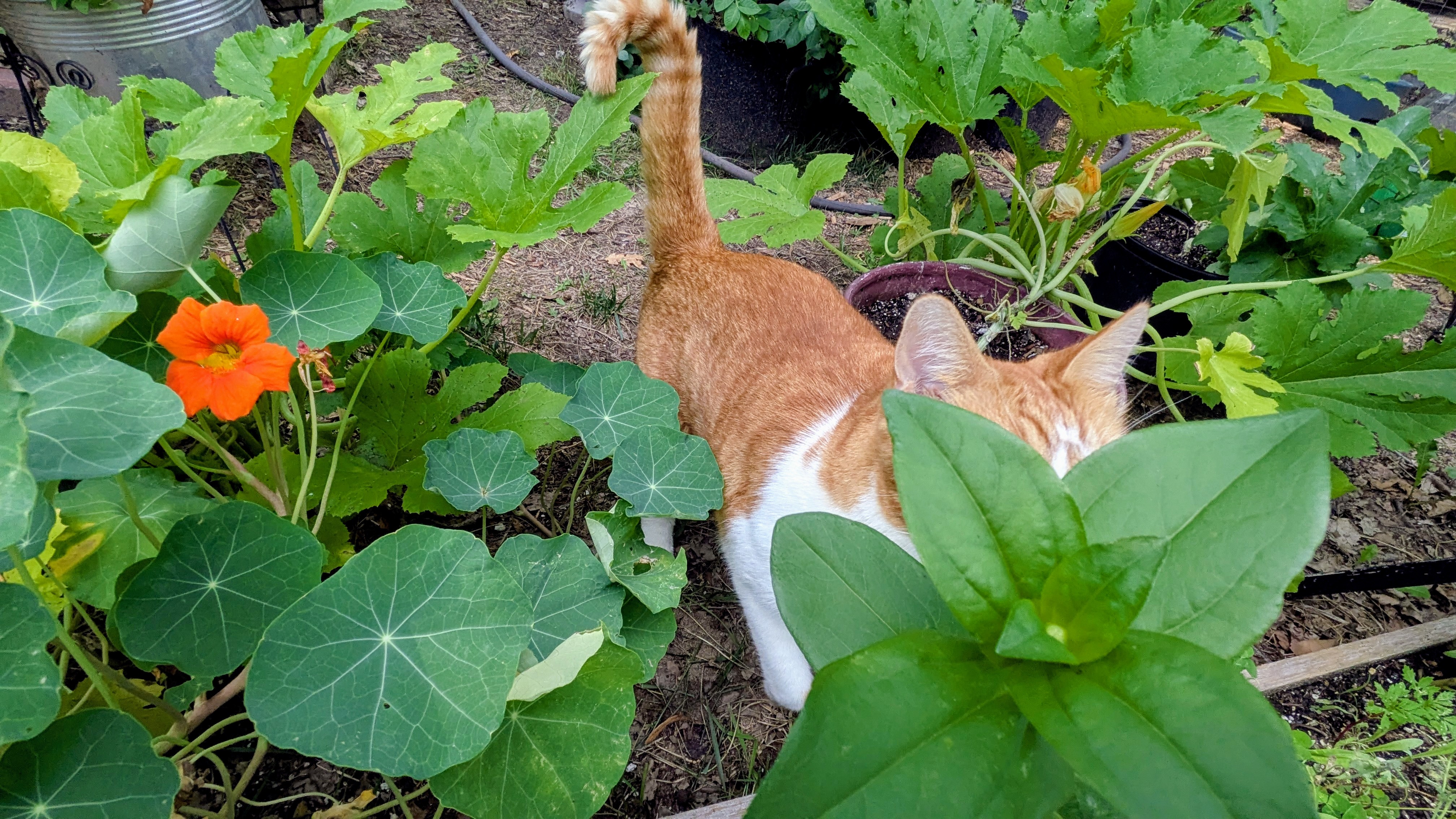
Fig. 5. Where's Snake? Photograph by Andrea Fabbro, 2025. Grand Rapids, Michigan.
Well, anyhow... What stands out most about my decision to go outside that afternoon was my assumption that I would pop in for a quick one-two, say hi and bye in practically the same breath, a round robin so fast I would be back inside in just a few minutes, to finally give up the day for my daily bed. In a practical sense, I think I just wanted to check to see if anything down there was dying of thirst in the August heat. But there was another thing in me that did not want to go down without a fight. One last-ditch leap into the blue, the green, the direction of Life. And where better to find Eros than the place where all the life was growing? The life-place. And if this final attempt to revive myself came up empty, then fine, I would resign knowing I had at least tried to breakaway into the adjacent woods, rather than slow march to the gallows, making nary a peep.
WHAT I didn't know was that what I would soon find in the garden would make any sleep, that day or that night, a virtual impossibility.
☠
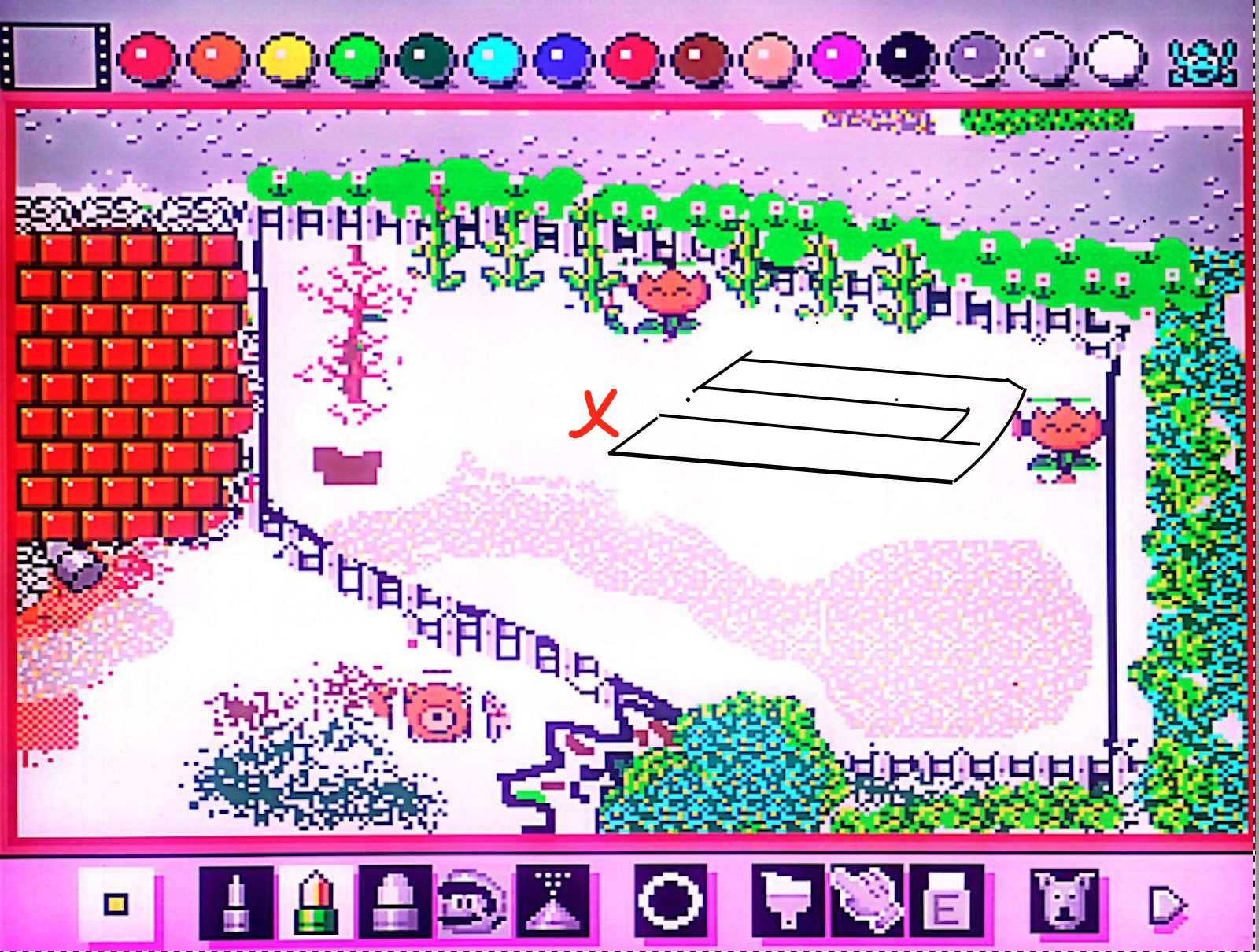
And so I was off to the races, running on some mysteriuous force of will and premium muscle memory. I opened the front door and stepped into the blinding sunlight, distracted by the image of my future self, lying in the dark, sunlight blotted out by curtains, but for a thin sliver of light. I lumbered expertly down the treacherous concrete steps of the front stoop, only half aware of the world around me. It was a mechanical journey onto the brick driveway and over to the wobbly offshoot of mismatched bricks that winds its way to my destination: a modest section of front yard cordoned off by welded wire fencing (Fig. 6).
Fig. 6. Aeriel View of Garden. Photograph by Andrea Fabbro, 2025. Grand Rapids, Michigan.
☠
I pulled open the flap in the fence that serves as a makeshift gate and walked a couple of steps down the path before I froze.
A wave of panic and confusion washed away the doldrums that had been bolted to my brain, along with the rote familiarity with which I had burst onto the scene, having mistakenly assumed the little patch of land would match the picture of it I stored in my head. An unfamiliar place glared back at me with a hostile brightness. It looked so washed-out, it could have been in black-and-white, a noirish facsimile of what once had been my garden. Fuzzy and surreal.
Tomatoes, chiles, snapdragons, and sage. They were all still there, rooted in the same positions where I'd initially planted them, only they were marginal, somehow. Withdrawn. Etiolated. Sapped of all signicance and demoted to the blurry background. No longer did they exist just for the hell of existing. Something else was taking place here, for which the plants formed the backdrop, scenic components of a bigger, increasingly alarming picture whose focal point was the garish monstrosity developing in real time before my eyes....
CLICK TO UNBLUR:
Whatever it was had caused my amygdala to pull the shrill alarms, signaling to my hypothalamus that something was indeed very, very... not right here — we were not alone in this world. But the absence of my cerebral cortex left me suspended in the stretch between seeing and knowing, feeling and understanding, frozen with revulsion in this grotesque reproduction of my garden. As long as I remained in this un-place, the culprit of the commotion was opaque, its location unclear. But it had to be somewhere, which meant it could be anywhere, and may as well have been everywhere: on my shoes, in the air, in my hair?
And where, pray tell, was my mind, the sanctimonious old so-and-so? I needed my thinking faculty if I ever hoped to claw my way out of the rift.
And then, like a lens coming into focus, my mind finally entered the fray, and the whole sordid scene crashed down on my full sensorium like a surreptious squall. The upside-down turned inside-out, the rift now a raft I could ride, the Schrodinger’s box now a boat, ferrying me from purgatory and back to life, back to who I was, back to where I was--which was where, exactly? And, oh god, who was this thing writhing on the ground a yard away from me? Something unsightly, unspeakable, something slithering and swallowing and being swallowed all at once. I had waltzed right into the lair of some kind of two-headed monster that had come to herald the end times.
☠
I was familiar with the Garter snake that had taken up residence in the garden, but that didn’t stop him from scaring the shit out of me every time I saw him slithering out of sight.
When it comes to snakes, my body is aware of the threat long before my mind catches up with it, and the in-between state, as the body battles the brain, becomes a battlefield ruled by abject, animal terror.
My cat, Maceo, whose real first name, incidentally, is Snake, has brought actual snakes inside of the house in summers past. As a direct result of Snake's actions, I am, on some level, always expecting to see a snake slithering around every corner.
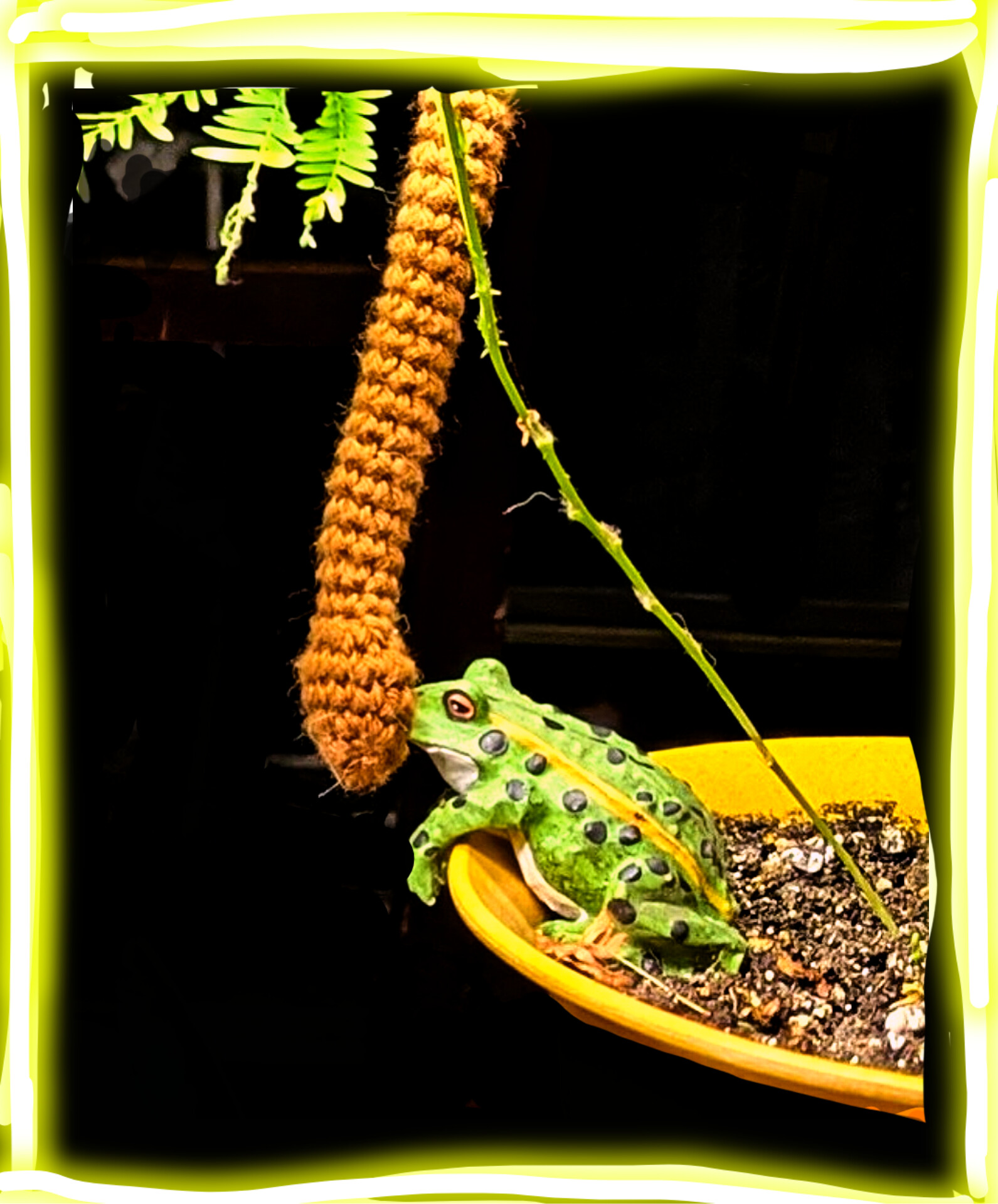
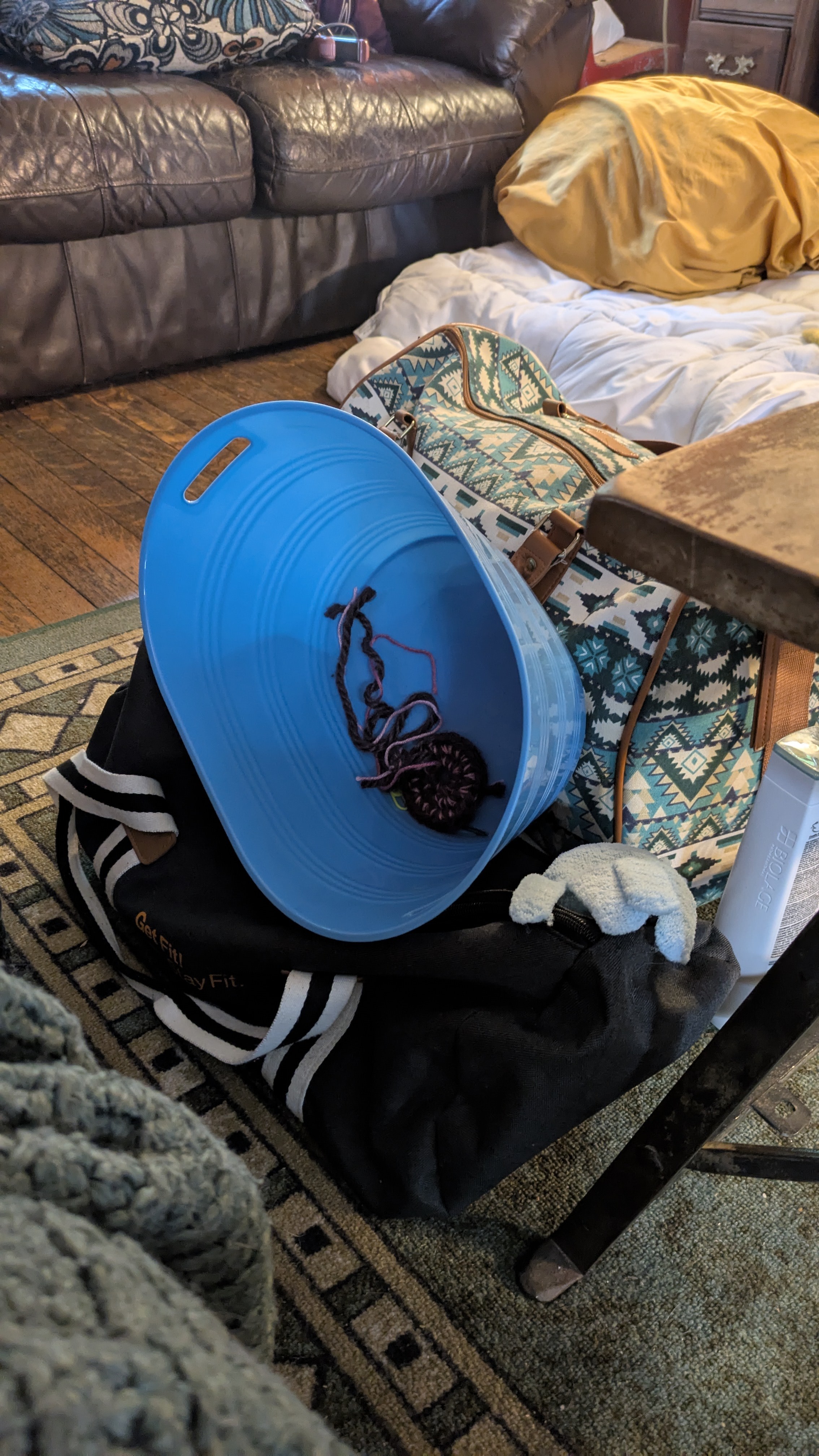
And it doesn't even need to be alive or real or a snake animate to count as a snake, in my mind, as the physiological reaction is the same. I can think of no better expression to captures this phenomemon than to jump out of one's skin. Indeed, that is more or less what happened to me a couple of months ago, when I saw, from the corner of my eye, a snake coiled up in a basket on the floor next to me, which sent me hurtling off the couch, out of my skin, and out of the stadium, before I realized it was just some loose yarn in a basket. (Fig. 7).
Fig. 7. Snake in Basket. Photograph by Andrea Fabbro, 2025. Grand Rapids, Michigan.
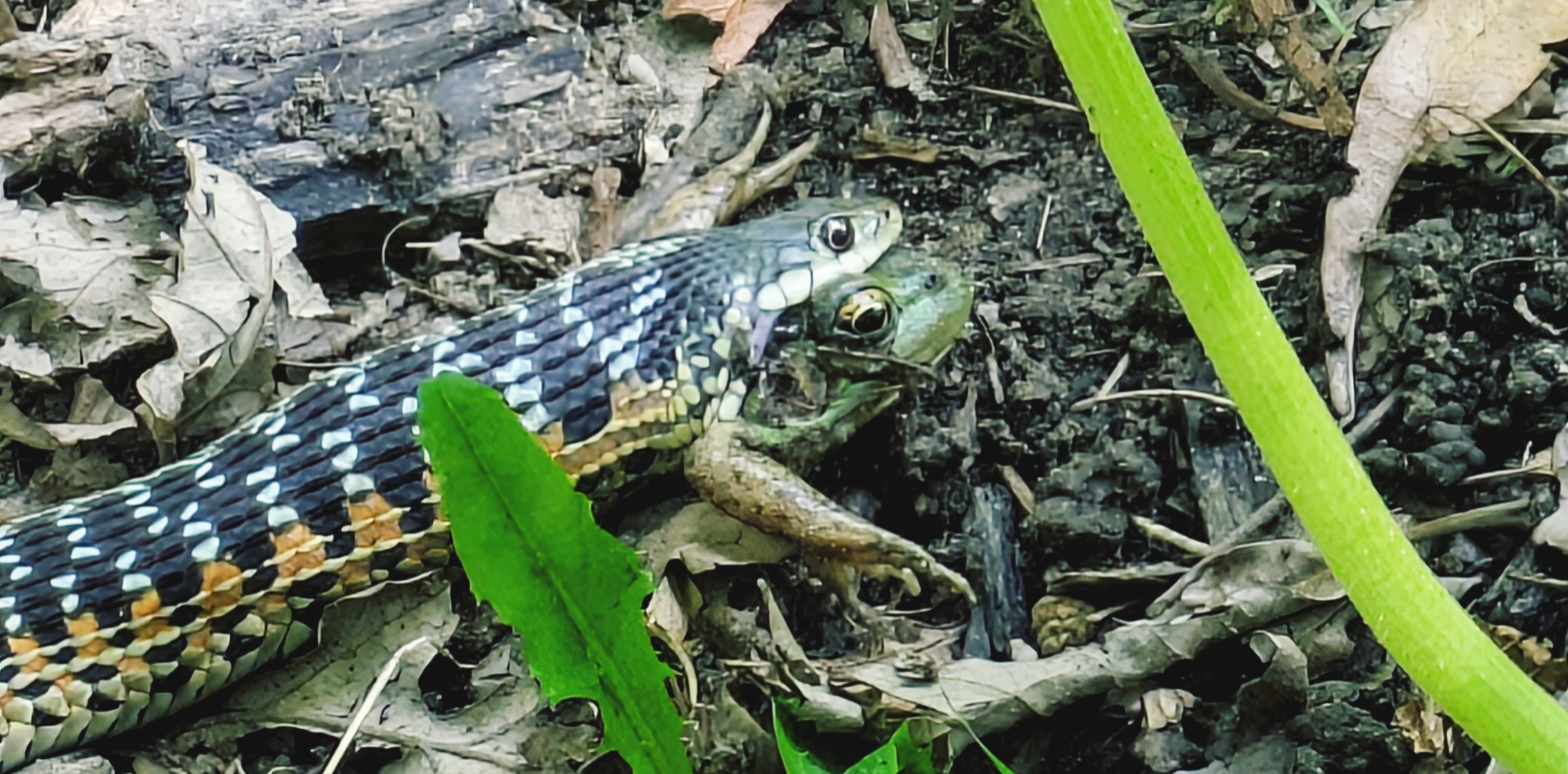
Unfortunately, this particular snake was not a string of yarn, nor was it an ordinary garter snake. Something was afoot at the foot of the tomato bed. The predator had already swallowed the frog’s hind legs and most of its torso, leaving only its front legs and its head. The snake’s mouth was open so wide to accommodate the bulky frog, I could not see his bottom jaw, which gave the illusion that the frog’s head was attached to the snake’s body. Its limp front legs, splayed helplessly out of the snake’s mouth, endowed the legless reptile with legs of its own. The sad amphibian was wearing the snake head, its eyes mute and detached, forming a monster, oddly writhing its obscene girth (Fig. 8).
Fig. 8. Snake Eats Frog. Photograph by Andrea Fabbro, 2025. Grand Rapids, Michigan.
In effect, the frog’s head and front legs looked like they belonged to the body of the bloated-beyond-belief garter snake, giving the unit the appearance of a small Komodo Dragon, or perhaps the Biblical serpent before God cursed it to crawl legless in unsuspecting vegetable gardens, scaring the shit out of people 4300 odd years later. This uncanny fusion of frog and snake: the frog’s much larger head and sympathetic eyes, locked in a position I can only interpret as sadness, wearing the the reptile’s upper jaw as some kind of unholy crown, jeweled with its small, black bead of an eye, were attached to the snake’s slithery, onestop body, ensued for the entirety of its strenuous supper.
There I stood, my jaw open as widely as the snake’s, witnessing the world’s slowest, most excruciating swallow.
The snake absorbed the enormous entrée in gruesome increments–like watching paint dry, or frogs boil, the snake’s tiny, inscrutable eyes much bigger than its stomach, which was already bulging with the body of a different animal. The frog’s eyes betrayed pain and fear, and, owing to an expressive slant of his eyelids, sadness. This was a violence so slow, it had time to feel tragic.
Impossible not to root for the frog, frozen as he was with fear and that melancholic expression. The whole scene reeked with the inevitabile disappearance of the frog from this world. At times, it would pathetically try to lunge forward, causing the snake to lunge with it, able to quickly assert control over the situation, on account of the fact that the frog was halfway down its throat. After each escape attempt, the sorry looking amalgam of reptile and amphibian would drag itself back to the usual, horrible position. And I did nothing to stop the situation.
The vulnerable snake would occasionally try to writhe its way to someplace more discreet when it noticed me, but his movements were as pathetic as those of his prey, a rising and falling movement, kind of like a broken wheel.
The most haunting part of the ordeal was the question of inevitability - imaging the initial moments when the snake first targeted his mark and sank his teeth in the slippery green skin. Did he strike at one leg first, relying on the ensuing shock to provide him time to devour the second? Did the frog try to bolt away, or was it immediately complacent? Could it have been possible, in that initial moment of contact, for the frog to run free, if he had only understood what was happening and reacted quickly enough? If so, what went wrong to cause him such paralysis?
On the other hand, was the frog's fate a foregone conclusion? Was there nothing the frog could do the moment the snake decided to eat him? And, if the latter is the case, are we all that vulnerable? Are we all so lucky, until we aren't? Are cultures, nations, and entire empires lucky, until they aren't? Until something decides to eat them.
The frog still tried to escape at times. He'd lunge forward with his dwindling strength, but it all appeared more like a twitch as the snake reasserted his grip on the utterly trapped prey.
I didn't stick around to watch the rest. It was easy to imagine what would go down, if you will excuse the pun. When I returned to the garden later, the snake was gone.
A different frog, as large as the one I had just watched swallowed whole, startled me, as it darted away to the crick that straddles the south side of the garden.